Year 12 A-Level Maths Is Destroying My Child's Confidence — What's Actually Going On?
Your child got Grade 8 at GCSE and is now struggling in A-Level Maths. This is not a sign they are not capable. A UCL neuroscientist explains the real reason the jump is so hard — and exactly what helps.
Not sure where your child's gaps are? Book a free A-Level Maths diagnostic — our PhD-led team will find exactly what's holding them back →
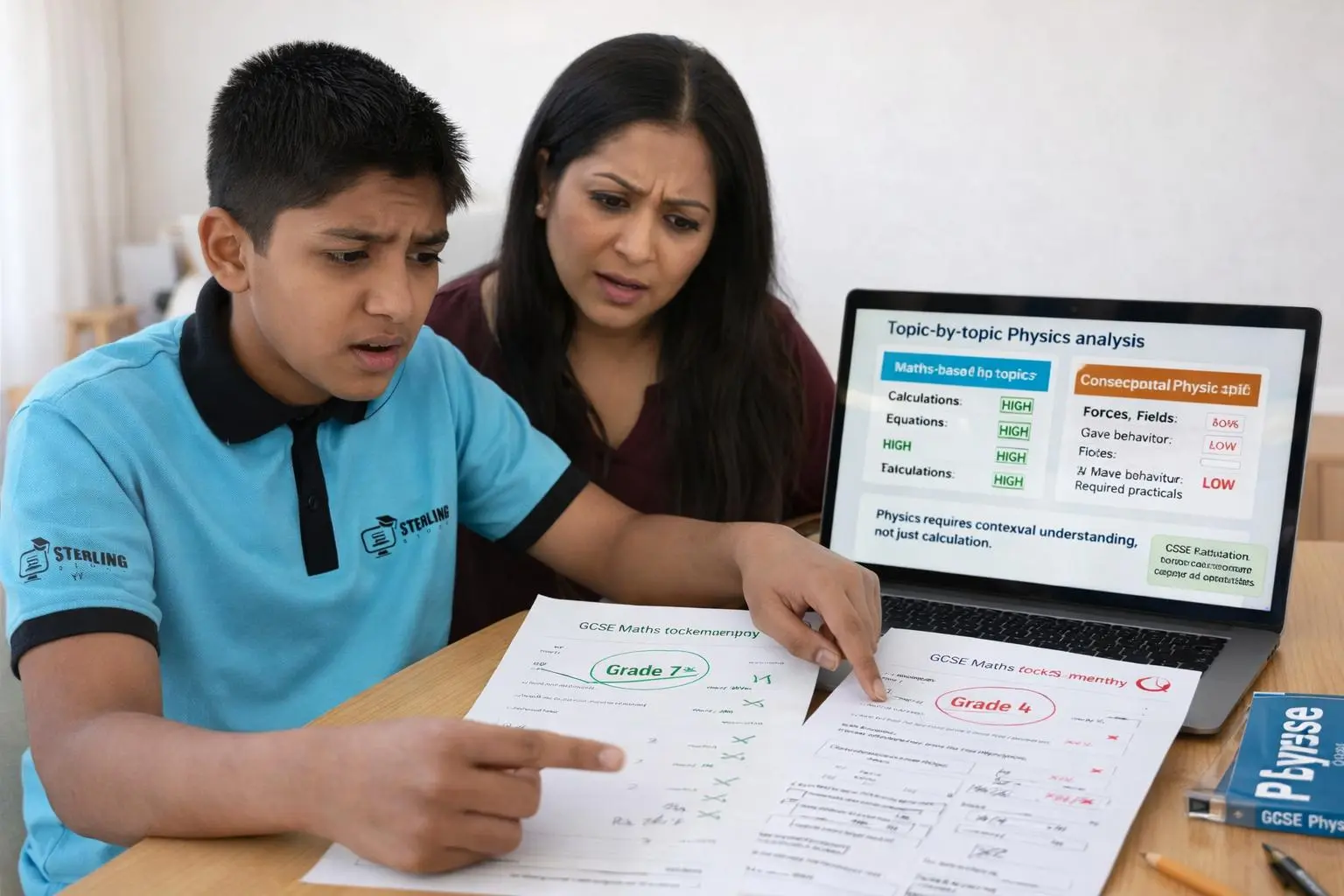
Rohan got Grade 9 in GCSE Maths. Grade 9. He was one of the top Maths students in his school. His mum messaged us in November of Year 12 after he scored 38% on his first mechanics test. "He says he doesn't understand it anymore," she wrote. "The teacher is going too fast and he can't keep up. This isn't my son. Is something wrong with him?" Nothing is wrong with Rohan. What he is experiencing is one of the sharpest — and least prepared-for — transitions in the entire secondary education system.
Fix them.
For free.
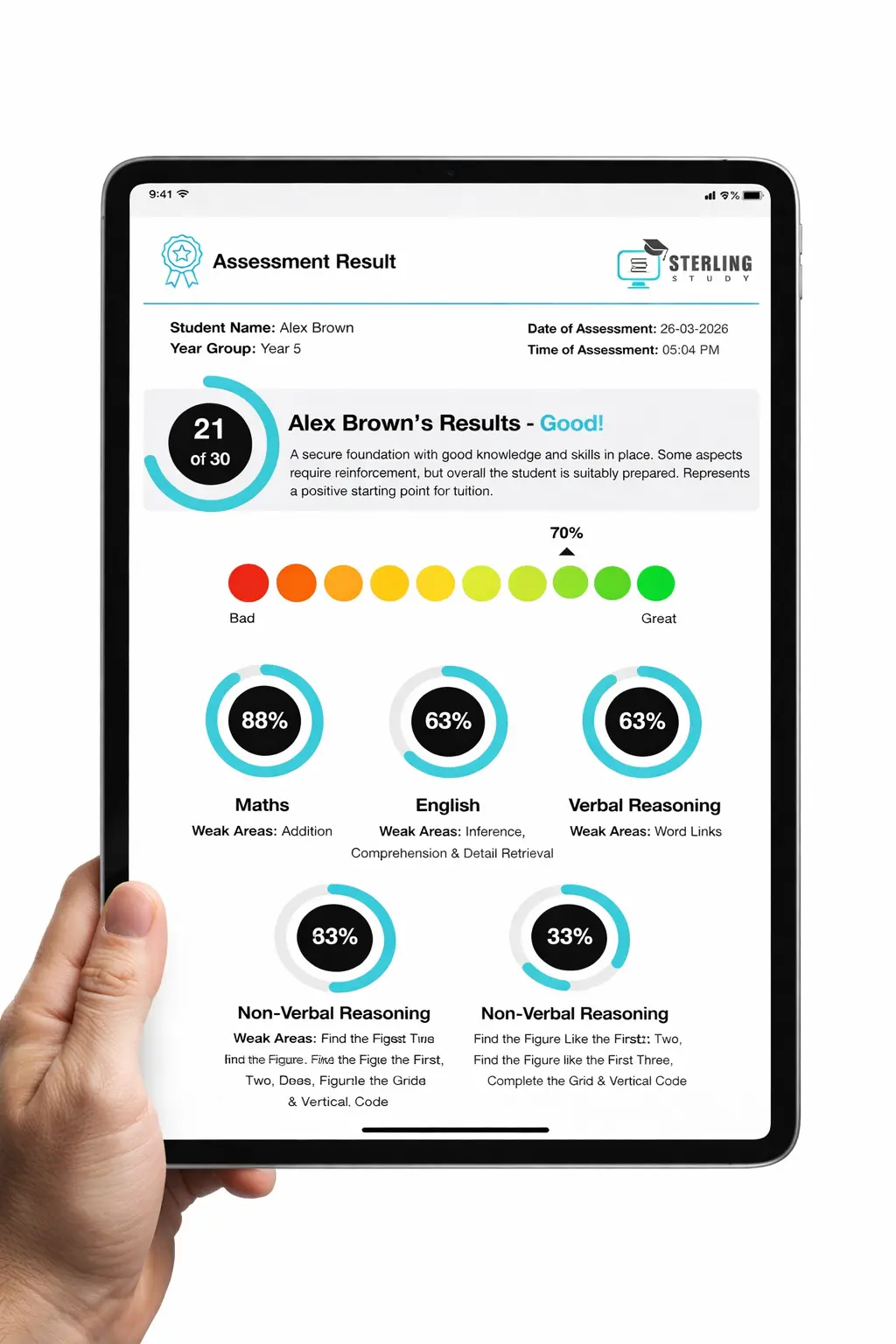
- ✓ Subject-by-subject breakdown across all Science topics
- ✓ Time-per-question analysis
- ✓ Where you stand vs grade boundaries
- ✓ Detailed PDF results sent immediately
- ✓ No strings attached
1. The Most Confusing Experience in Sixth Form
The GCSE to A-Level Maths jump is one of the steepest cliffs in the entire secondary curriculum — and almost no one tells students or parents it is coming. A student who sailed through with a Grade 8 or 9 can genuinely feel like they have lost their ability to do Maths within the first half-term of Year 12. That feeling is real. But it is also completely explainable.
The students who feel most blindsided by A-Level Maths are often the ones who found GCSE easiest. The skills that made GCSE feel natural are not the same skills A-Level demands. The transition requires building an entirely new cognitive toolkit — and that takes time, the right methods, and expert guidance.
The experience Rohan had is extremely common. It does not mean a student should drop Maths. It means they have hit a genuine step-change in cognitive demand and need support to navigate it — not reassurance, but structured expert intervention.
2. The Neuroscience of Why This Jump Is Uniquely Hard
Our lead tutors hold PhDs from UCL and Imperial, and the Sterling A-Level system was built with cognitive science at its core. Here is what the research actually tells us about this specific transition.
The sensation students describe — "I don't understand it anymore" — is not a failure of ability. It is encountering a different cognitive demand for the first time. That is a solvable problem when approached with the right teaching methodology.
3. The Topics Where Year 12 Students Hit the Wall First
Not all Year 12 Maths topics cause equal difficulty. There are five specific areas where students consistently hit their first wall — and each one has a specific reason why it trips students up, and a specific approach that resolves it.
| Topic | Why it causes the first wall | The specific approach that helps |
|---|---|---|
| Differentiation (Calculus) | New conceptual framework — not harder GCSE, genuinely new mathematics | Conceptual understanding before technique application |
| Trigonometry (Radians, Identities) | Requires identity manipulation, not just angle calculation | Build identity fluency through derivation, not memorisation |
| Mechanics (SUVAT, Newton's Laws) | Double cognitive demand: physics context + maths application | Clearly separate the physics model from the maths calculation |
| Statistics (Hypothesis Testing) | Abstract probabilistic reasoning with no GCSE equivalent | Teach the logical framework explicitly before the procedure |
| Proof / Algebraic Manipulation | Long algebraic chains needing precision GCSE did not demand | Build tolerance for multi-step algebra through graduated practice |
Many students do not realise Mechanics is a Maths topic until they are sitting in front of it. The double cognitive load — needing to model a physical situation AND execute the mathematics — is genuinely new. Separating these two operations in your approach is the single most effective fix.
4. The Metacognitive Habit That Changes Everything
Beyond content knowledge, A-Level Maths success requires a cognitive habit that GCSE never demanded: thinking about how to think before you start solving. This is called metacognition, and it is the single biggest differentiator between students who recover from a difficult start and those who do not.
This metacognitive habit — thinking about how to think — is what distinguishes A-Level mathematical performance from GCSE performance. It is not natural. It has to be taught explicitly, and our PhD-led tutors build it systematically into every session from day one.