GCSE Maths Tuition: Real Progress, Proven Results
GCSE Maths tuition with Sterling Study is online, PhD-led teaching that helps students master the full GCSE Maths syllabus and reach their target grade. Sterling Study is a UK-wide online tutoring company founded in 2020, and 90% of its GCSE Maths students achieve Grade 6 to 9. Our online GCSE Maths tuition combines small ability-matched groups, monthly progress tests, and a structured Read, Note, Recap method. GCSE Maths private tuition is also available for students who need focused one-to-one support to close gaps or push for a top grade.
"I always wanted a Grade 9 in GCSE Maths but was not sure I could get there. Sterling gave me the structure and support I needed, and I came out with a Grade 9 on results day."
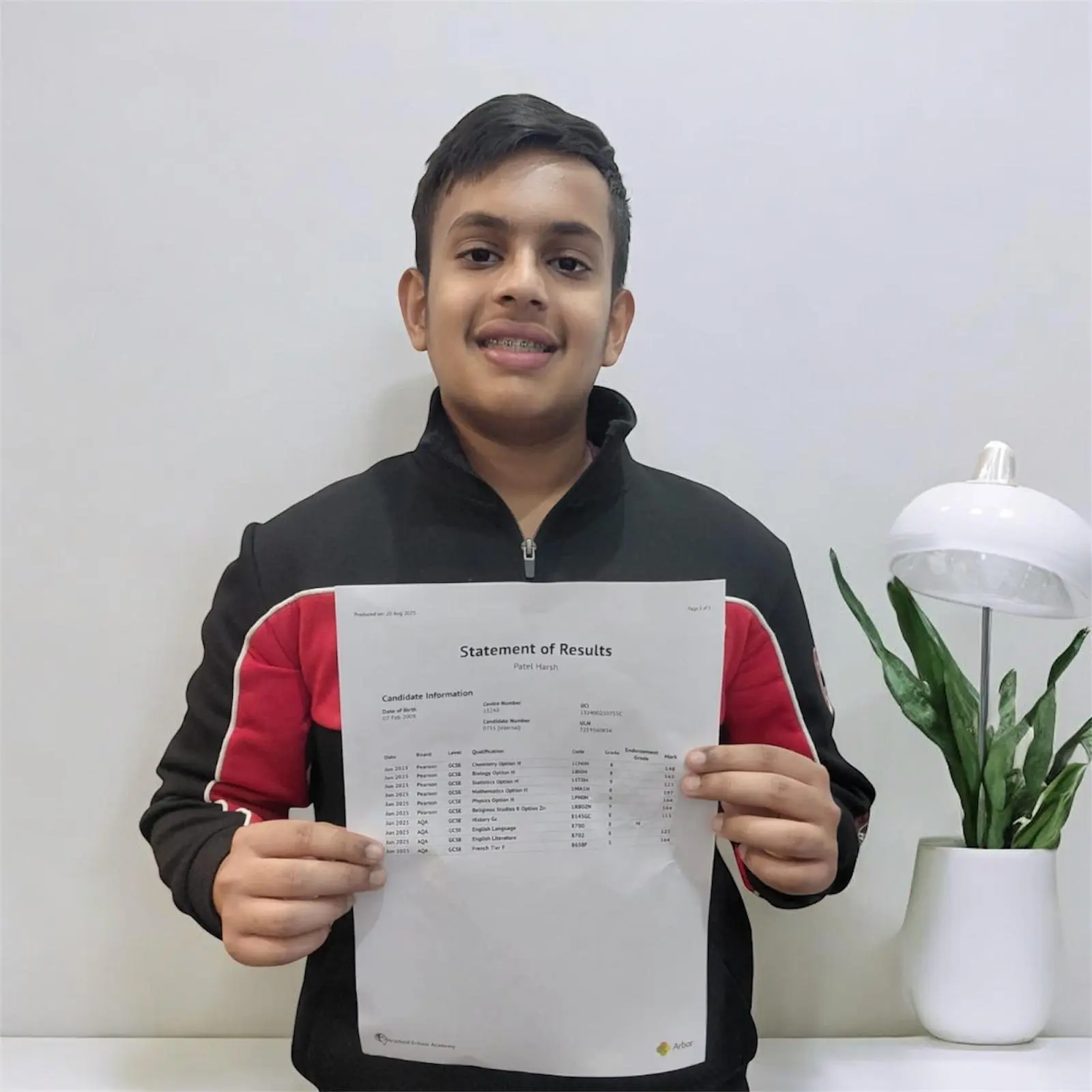
"Dharma has been with Sterling for GCSE Maths since 2020 and the progress has been outstanding. The structured teaching and monthly progress tests have kept him on track every step of the way."

"I was predicted a Grade 4 in GCSE Maths going into Year 11. My tutor broke down algebra in a way that finally clicked, and I came out with a Grade 7 on results day."

Choose the Right Option for Your Child
Two ways to learn GCSE Maths with Sterling Study. Most families start with small group classes for the structure and value, and add 1-to-1 where a student needs it.
Group Sessions
- Structured lessons following a planned curriculum
- Monthly progress tests and performance tracking
- Ability-matched groups, adjusted as your child improves
- Learn across subjects together, also available as GCSE Science and GCSE English
1-to-1 Tuition
- Personalised learning tailored to the student's needs
- Custom student-specific learning plan
- Ideal for closing specific gaps or stretching high achievers
- Flexible scheduling around your child's timetable
Numbers That Show What We Deliver
Our structured, data-led approach consistently produces grade improvements across all ability levels.
Meet Our Tutors
Sterling Study was founded by two PhD scientists who personally design the curriculum your child learns from, and oversee every specialist tutor who delivers it.

Parth holds a Neuroscience PhD from UCL and an MSc from Imperial College London, with research experience at the Francis Crick Institute. His background is in the science of how the brain learns and retains information.
Why this matters for your child: Parth builds the GCSE Maths teaching around proven memory and recall techniques, so students do not just cover the syllabus, they remember it under exam pressure.

Igors holds a PhD in Genetics from the University of Surrey and works as a Specialist Scientist at UCL. He leads the design of demanding exam-board content, turning it into clear, structured GCSE Maths lessons students can actually follow.
Why this matters for your child: Igors writes every worksheet, exam and lesson plan in-house, so the material is tuned to exactly what the exam boards reward, not generic bought-in content.
Every specialist tutor who teaches your child is chosen and overseen by Parth and Igors. All UK staff are DBS certified, and our Director, Ms Yesha Mukhtiar, is the named Safeguarding Officer. Because tuition is fully online, families searching for a GCSE Maths tutor near me are never limited by geography, whether you are in London, Birmingham, Coventry, Wembley or East Ham, sessions run live, UK-wide.
Why Choose Sterling Study for GCSE Maths?
Expert teaching, measurable results, and a system built to keep both students and parents informed every step of the way.
Who teaches GCSE Maths at Sterling Study?
GCSE Maths tuition at Sterling Study is led by subject specialists overseen by two PhD founders, Dr Parth Patel (UCL) and Dr Igors Pupko (Surrey). All UK staff are DBS certified, and every tutor teaches online across the UK. Meet the team →
Data-Driven Progress Tracking
Monthly progress tests, results shared via WhatsApp, and group adjustments based on real performance data. Nothing is left to guesswork. Learn more
Free Intervention Sessions
Students who score below expectations receive free 1-to-1 catch-up sessions. We close learning gaps immediately, at no extra cost.
No Contracts, No Risk
Free assessment. Free trial class. No fixed contracts. We earn your trust month by month through results, not paperwork.
Parent App & Learning Portal
Track progress, view areas of concern, manage payments, and earn referral rewards from the Sterling mobile app. Explore our app
Free Weekly Exam Club
A live weekly revision session with exam-style maths questions and real-time tutor support, included at no extra charge.
How does online GCSE Maths tuition work?
Free Assessment
Your child takes a diagnostic maths assessment covering all major GCSE topic areas. We produce a detailed PDF report pinpointing strengths, gaps, and their current working level. Completely free, no obligation.
Personalised Placement
Assessment data determines the right tutor and ability-matched group for your child. No guesswork. Real data drives every placement decision.
Expert-Led Live Classes
Interactive online sessions delivered by specialist maths tutors. Each class is structured around the exam syllabus with worked examples, exam-style questions, and real-time Q&A.
Monthly Progress Testing
Every month, your child sits a progress test via our student portal. Results are shared directly with you via WhatsApp and through the Sterling Parent App. Group placement adjusts as performance evolves.
Targeted Intervention
When scores dip, we step in fast. Students receive free one-to-one sessions to close specific gaps immediately, at no extra cost.
What is the difference between Foundation and Higher tier GCSE Maths?
Foundation tier GCSE Maths covers grades 1 to 5 and is designed for students working towards a secure pass. Higher tier GCSE Maths covers grades 4 to 9 and is designed for students aiming for the top grades. Sterling Study teaches the complete GCSE Maths syllabus across both Foundation and Higher GCSE Maths, spanning Number, Algebra, Geometry and Statistics, and aligned to AQA, Edexcel and OCR. Your child's tier is confirmed during the free diagnostic assessment.
Number
- Integers, decimals and fractions
- Powers, roots and surds
- Standard form and indices
- Percentage calculations and change
- Ratio, proportion and rates of change
- Error intervals and bounds
Algebra
- Simplifying and expanding expressions
- Solving linear and quadratic equations
- Simultaneous equations
- Sequences and nth term
- Graphs, gradients and functions
- Inequalities and iteration
Ratio & Proportion
- Simplifying and using ratios
- Direct and inverse proportion
- Speed, distance, time problems
- Currency and unit conversions
- Best-value comparisons
- Compound measures
Geometry & Measures
- Area, perimeter and volume
- Angles, parallel lines and polygons
- Circles, arcs and sectors
- Transformations and vectors
- Trigonometry and Pythagoras
- Constructions and loci
Statistics
- Mean, median, mode and range
- Frequency tables and grouped data
- Histograms and cumulative frequency
- Box plots and scatter graphs
- Correlation and lines of best fit
- Sampling and data collection
Probability
- Basic probability and outcomes
- Mutually exclusive events
- Tree diagrams and Venn diagrams
- Conditional probability
- Relative frequency and expected value
- Combined events
What topics and exam boards are covered in GCSE Maths?
The most widely used GCSE Maths board in England. Structured papers with a balance of fluency and problem-solving questions.

Emphasises application of mathematical reasoning and multi-step problem solving across all three papers.

Places strong emphasis on mathematical communication and synoptic reasoning across Foundation and Higher tiers.
How does the GCSE Maths 9 to 1 grading system work?
GCSE Maths is graded on a 9 to 1 scale, where 9 is the highest grade and 4 is a standard pass. The 9 to 1 scale replaced the old A* to G system in 2017. A Grade 5 is considered a strong pass, and Sterling Study's GCSE Maths tuition targets Grade 6 to 9 for the majority of its students.
| Grade | Equivalent | What It Means |
|---|---|---|
| 9 | Above A* | Exceptional performance. Awarded to the top 3-4% of students nationally. |
| 8 | High A* | Outstanding achievement. Strong preparation for A-Level Maths. |
| 7 | A | Excellent result. A solid foundation for further study. |
| 6 | High B | Good pass. Acceptable for many A-Level and college courses. |
| 5 | Low B / High C | Strong pass. Meets the threshold for most sixth forms and college entry. |
| 4 | C | Standard pass. Minimum requirement for most employment and further education. |
| 3 | D | Below standard pass. Re-sit often required in post-16 education. |
| 2 | E | Low achievement. Does not meet standard pass requirements. |
| 1 | F / G | Minimum assessed grade. Significantly below standard pass. |
| U | Ungraded | Insufficient marks to award a grade. |
How UK Students Are Performing in GCSE Maths
National pass rates tell a story. The gap between what is typical and what is achievable with the right support is significant.
Why GCSE Maths Matters
A strong GCSE Maths grade is one of the most universally required qualifications in the UK. The doors it opens are significant.
University Entry
The vast majority of UK universities require a minimum Grade 4 or 5 in GCSE Maths as a baseline for degree admission, regardless of subject.
Career Pathways
Finance, engineering, healthcare, law, and technology all require a strong GCSE Maths pass. It is one of the most frequently cited requirements in job applications.
A-Level Progression
A Grade 6 or above is typically required to take A-Level Maths or any science at sixth form. Grades 7 to 9 open further options including Further Maths.
Apprenticeships
Higher and degree apprenticeships with leading employers in engineering, finance, and technology require a Grade 4 or 5 at minimum, with competitive employers asking for Grade 6.
Frequently Asked Questions
Quick answers to the questions parents ask most.
Speak to Us
Fill in your details and we will be in touch. Most parents hear back within two hours.
By submitting you agree to our Privacy Policy. No spam, ever.
Or reach us directly
Mon to Sat, 9am to 7pm
We respond within two hours
Online tuition, learn from anywhere in the UK
Explore Our Other Courses
Supporting students from KS2 through to A-Level.




Latest GCSE Maths Resources & Guides
Free revision guides, exam strategies, and study tips from our team of PhD scientists.
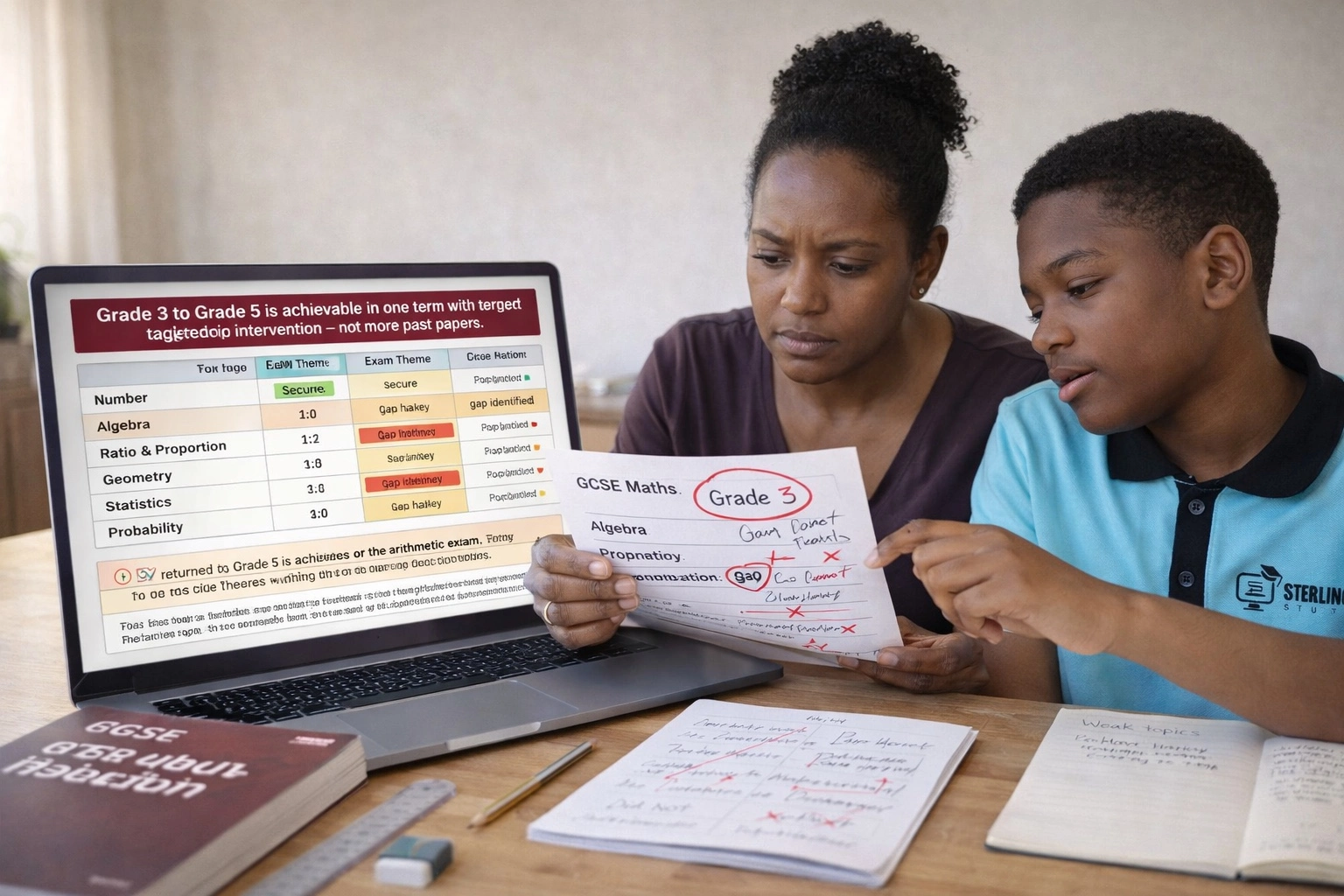


Ready to Help Your Child Succeed in GCSE Maths?
Start with a free, no-obligation assessment. We will pinpoint exactly where your child needs support and show you how our programme can help them reach their target grade.
Book Your Free Assessment Now →Secure Your Child's GCSE Maths Place for the New Term
The new term is already underway, and 90% of students achieve Grade 6 or above in GCSE Maths. Start early for the most time to build on key topics before mocks.
Book Now →