A student arrives. Biology: Grade 6. Chemistry: Grade 5. Physics: Grade 3. Parents are baffled. How can a child be competent in two of the three Sciences and struggling badly in the third? The answer, once you understand it, changes everything about how you approach revision.
✓ FREE · 30 mins · No ObligationFind your gaps.
Fix them.
For free.
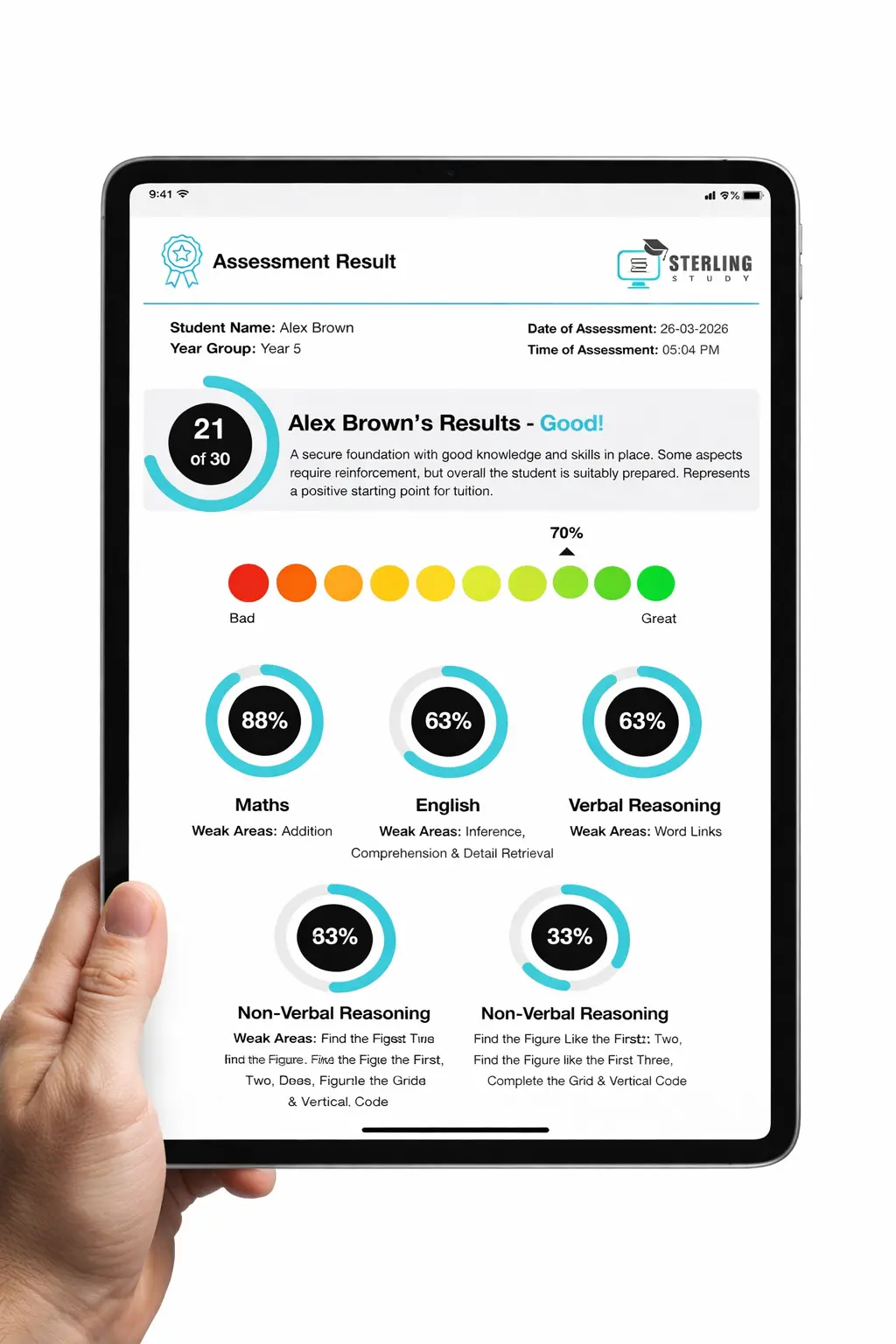
Not sure where the gaps in your knowledge are? Our PhD-led team uses a diagnostic assessment to find exactly what is holding you back before you even start.
- ✓ Subject-by-subject breakdown across all Science topics
- ✓ Time-per-question analysis
- ✓ Where you stand vs grade boundaries
- ✓ Detailed PDF results sent immediately
- ✓ No strings attached
Find My Gaps - Book Free Assessment → 1. The Physics Gap — Why It Happens
Here is a pattern I see so consistently I have given it a name: The Physics Gap.
The answer to why it happens is not that Physics is harder than Biology. It is that GCSE Physics is not primarily a Science exam. It is a mathematics exam with a Science syllabus.
The core problem in plain terms
A student who cannot reliably rearrange equations, read velocity-time graphs, or convert between units will find roughly 30% of GCSE Physics marks genuinely inaccessible — not because they do not understand Physics, but because they do not have the mathematical fluency Physics requires.
Biology rewards memory, understanding and the ability to explain. Chemistry sits somewhere in the middle — it requires some calculation, but conceptual understanding carries a lot of the marks. Physics, by contrast, demands mathematical fluency as a foundation. Without it, every topic becomes a wall.
This is why so many students arrive with a Biology 6 and a Physics 3. They are not bad at Science. They are being asked to do applied mathematics without the tools to do it.
2. The Numbers Behind the Challenge
The gap between Biology and Physics grades is not anecdotal. The data from our own student intake makes the pattern impossible to ignore — and so does the specification itself when you look closely at it.
Sterling Study intake data — average Physics grade improvement of 2.1 after 12 weeks of targeted support
~30%
Maths-Dependent
Marks requiring mathematical calculation in AQA Physics
23
Named Equations
All must be recalled, applied and rearranged in AQA Higher Physics
3.8
Avg Physics Grade
On Sterling Study intake — vs average Biology grade of 5.6 in the same students
5.9
After 12 Weeks
Average Physics grade after targeted support — a 2.1 grade improvement
Why the equation sheet is not the safety net parents think it is
AQA does provide an equations sheet for some equations — but not all. Students must still select the correct equation from the sheet, substitute values correctly, and rearrange it. The sheet does not remove the need for mathematical fluency. It simply means a student does not have to memorise every formula — they still have to use them under exam pressure.
3. The Six Topics Where Most Marks Are Lost
Physics failure is rarely evenly distributed. The same six topic areas account for the majority of dropped marks across almost every student we see. Each one has a root cause — and each has a targeted fix.
⚡Electricity & Circuits
Root cause: Ohm's Law rearrangement and IV graph reading. Students can describe circuits but fall apart when the calculation begins.
Fix: Maths fluency drilling + equation practice in varied formats
📈Forces & Velocity-Time Graphs
Root cause: graph gradient = acceleration; area under graph = displacement. Two concepts most students have never been explicitly taught.
Fix: Graph interpretation skills taught as a standalone skill
🌊Waves & Wave Equation
Root cause: v = fλ applied to unfamiliar contexts. Students memorise the equation but cannot apply it when the question is phrased differently.
Fix: Equation practice across varied question formats and contexts
💡Energy & Efficiency
Root cause: percentage efficiency calculations and Sankey diagram interpretation. Often rushed in school because it appears straightforward — it is not.
Fix: Visual method for Sankey diagrams explicitly taught and practised
☢Radioactivity & Half-Life
Root cause: half-life graph reading and curve-based calculation. Students know what half-life means but cannot extract values accurately from graphs.
Fix: Graphical method with worked examples until the technique is automatic
🌞Space Physics
Root cause: often covered last and rushed; standard form required throughout. Students run out of time to learn it properly and deprioritise it in revision.
Fix: Prioritise in revision — high exam question frequency makes this high-value
4. The Sterling Study Physics Gap Protocol
When a student arrives with a significant Physics gap, we do not simply start working through the Physics specification from Topic 1. We follow a structured five-step protocol that addresses the root cause — mathematical fluency — in parallel with the Science content itself.
01
Assess Maths Fluency
Equation rearrangement, graph reading and unit conversion tested separately from Physics content.
02
Address Maths Foundations
Maths gaps fixed in parallel — not instead of — Physics content sessions.
03
Teach for Understanding
Physics concepts taught for genuine understanding. Why does v = fλ, not just how to use it.
04
Apply to Exam Questions
All content applied to AQA / Edexcel / OCR exam-style questions under real conditions.
05
Monthly Topic Test
Physics-specific breakdown sent to parents. They see exactly which topics improved and by how much.
Combined Science parents: Physics pulls your combined grade down harder than you think
Combined Science grades are averaged across all six papers. A significantly weak Physics score pulls the overall combined grade down materially — often more than parents expect. A Grade 3 in Physics can drag a Grade 6 Biology and Chemistry student to a combined grade significantly below what their Science knowledge deserves.
Frequently Asked Questions
How much does Physics count in Combined Science?+
Combined Science grades are averaged across all six papers — two Biology, two Chemistry and two Physics. A significantly weak Physics score pulls the combined grade down materially, often more than parents expect. A student with strong Biology and Chemistry can still finish with a combined grade well below their actual Science capability if Physics is not addressed.
What grade does a student need in Physics for A-Level Physics?+
Most sixth forms require a Grade 6 in Combined Science or Triple Physics, plus a Grade 6 in GCSE Maths. Some competitive sixth forms require Grade 7 in both. This makes the Physics gap especially high-stakes for students considering any science, engineering, medicine or technology pathway post-16.
Does AQA provide the equations in the Physics exam?+
AQA provides an equations sheet for some equations — but not all. Students must still select the correct equation, substitute values accurately and rearrange correctly under timed conditions. The equation sheet does not remove the need for mathematical fluency. It simply reduces one layer of memorisation — the application remains entirely dependent on the student.
Is this a Maths problem or a Physics problem?+
It is both — and that is exactly why most interventions fail when they treat it as only one or the other. Students who receive Physics tuition without addressing underlying maths fluency continue to struggle with the calculation-heavy topics. Our protocol addresses both in parallel from the first session.
How quickly can we expect to see a Physics grade improve?+
In our cohort, students on the Physics Gap Protocol average a 2.1 grade improvement over 12 weeks of targeted support. Results depend heavily on when a student starts — a student who begins in Year 10 has more runway than one who begins in April of Year 11. Either way, the first step is a free diagnostic so we know exactly where to focus from session one.
Our Course
GCSE Science Programme — Biology, Chemistry & Physics
PhD Scientist-led system · Online · No contract