What Do SATs Results Actually Mean? The Honest Parent's Guide (2026)
Schools can view 2026 KS2 SATs results from Tuesday 7 July, and parents receive them before the end of the summer term. Here is exactly what scaled scores mean, why SATs results matter more than most parents realise, and what to do next - with guidance from Sterling Study's PhD-led tutors.
Not sure where your child stands? Book a free diagnostic - our PhD Scientist-led team will find exactly what's holding them back →
SATs results explained simply: schools can view 2026 KS2 SATs results from Tuesday 7 July, and parents receive them before the end of the summer term, usually through a parent meeting, end-of-year report or school letter. Results are reported as scaled scores between 80 and 120, with 100 marking the expected standard and 110+ showing a higher standard ("greater depth"). SATs results matter more than many parents realise: secondary schools use them for setting, identifying gifted and talented pupils, and sometimes for early GCSE entry. There's no Science SATs paper, but most secondary schools run their own Science baseline test in Year 7, which is exactly the gap this guide helps you close.
Results day for SATs doesn't come with the same drama as GCSE or A-level results, no queuing at the school gates, no envelopes torn open on camera for the local news. Instead, it arrives quietly: a letter, a parents' evening slot, maybe a paragraph buried in an end-of-year report. That quietness is exactly why so many parents are left staring at a scaled score with no real idea what it means, whether it's good, or whether it matters at all. This guide answers all of that directly, with the actual 2026 dates, how the scoring system works, and what genuinely happens next. I'm Dr Parth Patel, and alongside Dr Igors Pupko, I built Sterling Study's SATs curriculum around exactly these questions, because what comes after results day usually matters more than the number itself.
Find out.
For free.
- ✓ Subject-by-subject readiness check across Reading, GPS and Maths
- ✓ A first look at Science, which isn't tested at SATs but is assessed early in Year 7
- ✓ Where they stand against the Key Stage 3 starting point
- ✓ Detailed PDF results sent immediately
- ✓ No strings attached
What Are SATs and Why Do Year 6 Pupils Sit Them?
SATs (Standard Assessment Tests) are statutory government assessments sat by Year 6 pupils across England at the end of Key Stage 2. "Statutory" means schools don't get to opt out: every state-funded primary school must administer them, with only a small number of exceptions made by headteachers for pupils with significant additional needs. Independent schools can choose whether to take part, which is why not every Year 6 pupil in the country sits the same tests.
The tests cover English reading, English grammar, punctuation and spelling (GPS), and Maths. Writing and Science work differently: writing is assessed by your child's own teacher based on a portfolio of classroom work across the year, not a single exam, and there is no separate Science SATs paper at all, something we'll come back to later because it has real consequences for Year 7.
It helps to think of SATs less as a hurdle your child either clears or doesn't, and more as a snapshot. The result tells your child's secondary school roughly where they're starting from in core subjects, and it tells you, the parent, where the gaps are before September arrives. Used well, that's genuinely useful information rather than a verdict.
When Do SATs Results Come Out in 2026?
For the 2025 to 2026 academic year, KS2 SATs were sat over four days from Monday 11 May to Thursday 14 May 2026. From there, the process moves in two distinct stages, and it's worth knowing both, because confusion about timing is one of the most common reasons parents think something has gone wrong when nothing has.
Schools, not parents, see the results first. According to the Department for Education's own guidance for parents, schools can view KS2 test results online from Tuesday 7 July 2026, via the National Curriculum Assessments Portal, with results becoming visible to nominated school staff from 7:30am that morning. Your child's school then decides exactly how and when to share results with you, but they are required to make sure you have them before the end of the summer term.
There is no national parent portal where you can look up your own child's SATs results independently, and there is no SATs results app beyond official school communications. If you haven't heard anything by the last week or two of the summer term, the right move is to ask your school directly rather than search for a workaround, since the format (letter, meeting, or report) genuinely varies between schools.
A number of websites invite parents to "check SATs results" by entering a child's name or school details. None of these have any official standing, and individual pupil results are never published anywhere public. Your child's school is the only source for their actual result, full stop.
For the official version of all of this, the Department for Education publishes detailed guidance every year, and the 2026 key stage 2 national curriculum tests guidance for parents is worth bookmarking if you want the primary source rather than a summary.
How to Read Your Child's SATs Results: Scaled Scores Explained
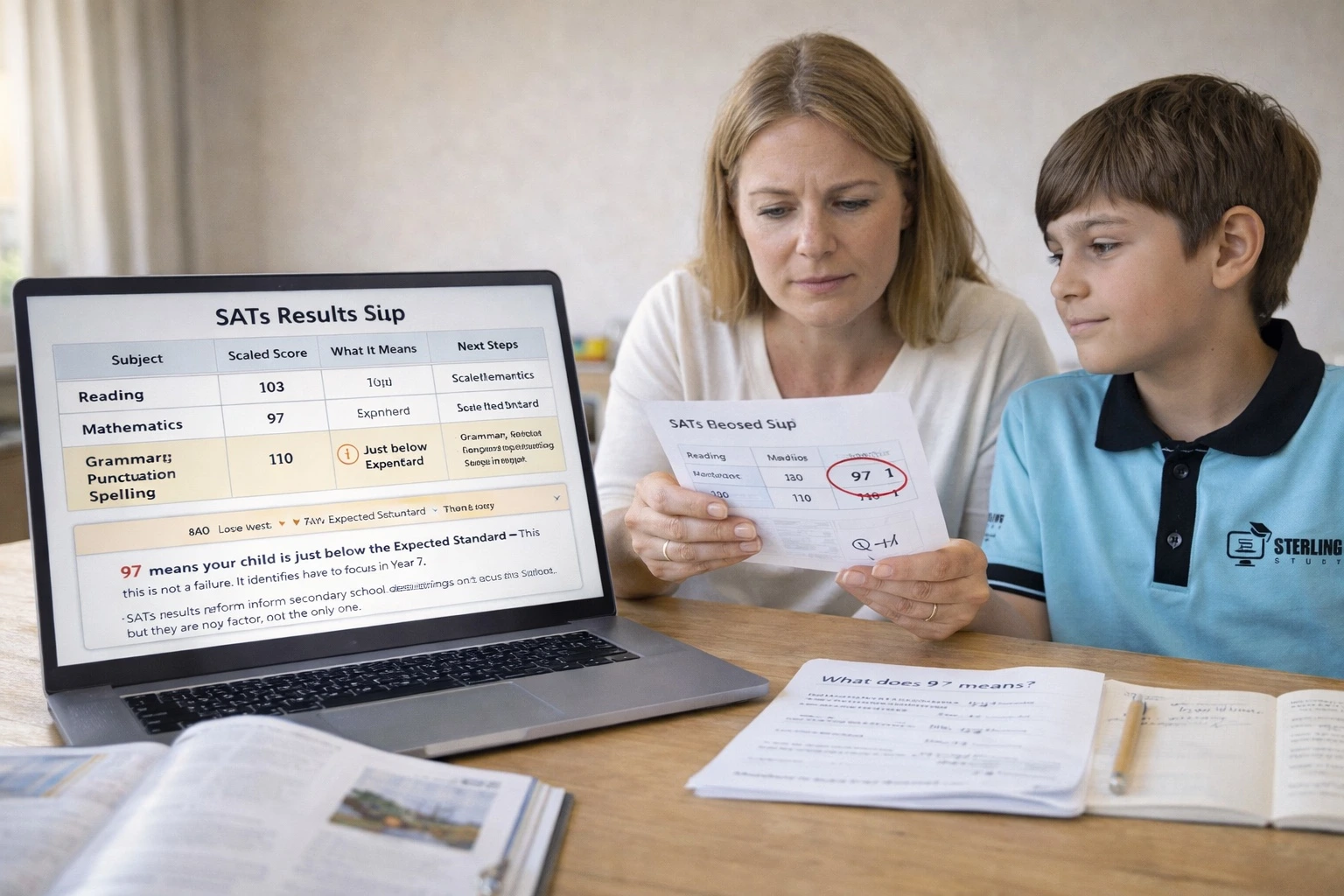
This is where most of the confusion sits, and it's worth slowing down for. Your child doesn't get a percentage, a grade letter, or a simple pass or fail. Instead, each subject is reported as a scaled score, a number that runs from 80 to 120, with 100 set as the expected standard for the end of Key Stage 2.
The reason scaled scores exist rather than raw marks out of, say, 50, is fairness across years. Test papers vary slightly in difficulty from one year to the next, so a raw mark of 38 in 2025 might represent a different level of attainment than the same raw mark in 2026. The scaled score adjusts for that, so a 100 always means the same thing, hitting the expected standard, regardless of which year your child sat the test or how hard that particular paper happened to be.
| Scaled Score | What It Means |
|---|---|
| 80–99 | Working towards the expected standard |
| 100 | The expected standard for the end of KS2 |
| 110–120 | A higher standard, often referred to as "greater depth" |
A score of 100 is genuinely good news. It means your child has met the standard the government expects of every pupil at this stage, not a borderline or scraping-by result. Anything from 110 upward signals they're working considerably beyond that baseline, with the strongest demonstration of attainment clustering toward the top of the 110 to 120 range.
Each scaled score is converted from a raw score, the actual number of marks your child achieved out of the total available on the paper. The Standards and Testing Agency publishes the raw-to-scaled conversion tables for that year's tests once results are released, because the conversion shifts slightly year to year to keep things fair. You won't usually need to do this conversion yourself; your child's results report will show the scaled score directly.
What SATs Score Is Good, and What Counts as Greater Depth?
Parents often ask this slightly differently depending on what they're really worried about, so it's worth separating the two questions properly.
If you're asking "is my child okay?", the answer is simple: a scaled score of 100 or above in Reading, GPS and Maths means your child has met the expected standard across the board. That's a solid, complete result, and there's no asterisk attached to it.
If you're asking "is my child exceptional?", that's where greater depth comes in. A scaled score of 110 or above is generally treated as a higher standard of attainment, and within teacher assessment for writing, "greater depth" is a specific descriptor used alongside the expected standard to flag pupils working noticeably beyond their year group's typical output. It isn't a separate exam or a bonus round, it's the upper end of the same scale, reflecting consistently strong, independent work across a range of question types and text complexities.
- ✓ 80–99: Working towards the expected standard, with specific support usually identified by the school.
- ✓ 100: Met the expected standard, the baseline the government sets for every Year 6 pupil nationally.
- ✓ 110–120: Working at a higher standard, often described as greater depth, particularly in writing and reading.
- ✓ 120: The maximum possible scaled score, representing the strongest demonstrated attainment on that year's paper.
It's worth saying plainly: a score in the 100 to 109 range is not a disappointing result. It sits comfortably within "met the expected standard," and plenty of pupils who go on to thrive at GCSE level start from exactly there. Greater depth is a marker of exceptional performance, not the line between success and failure.
What Do SATs Results Look Like, and How Are They Reported to Parents?
There's no single national template for the document you'll receive, since this is left to individual schools, but most results reports follow a similar shape. Expect to see your child's name and school, a scaled score for each tested subject (Reading, GPS, Maths), a clear statement of whether the expected standard was met, and a teacher assessment outcome for writing and, separately, for Science.
Most schools fold this into the end-of-year report alongside teacher comments on effort, behaviour and progress across the wider curriculum, rather than sending it as a standalone document. Many also offer a short meeting, sometimes the regular end-of-year parents' evening, sometimes a dedicated SATs discussion, where you can ask your child's teacher to talk you through the numbers directly. If anything on the report is unclear, that conversation is usually the fastest way to get a straight answer, faster than searching for an explanation online.
If your child's school operates a secure online portal or app for sharing reports, you'll typically log in with school-issued credentials rather than a public sign-up. It's reasonable to ask your school exactly how that access works and how your child's data is protected before you enter any personal details, the same caution you'd apply to any system handling a child's information.
Do SATs Results Matter? Do They Affect Secondary School?
Here's the headline most parents want first: SATs results do not affect which secondary school your child is offered a place at. Secondary school admissions run on catchment area, school preference order, sibling links and, for selective schools, entrance exam performance, not on Key Stage 2 SATs scores. If you're anxious about the admissions process specifically, you can let that particular worry go.
That doesn't mean SATs results disappear once your child has their secondary place confirmed. They follow your child into Year 7 and get used in several concrete ways:
- ✓ Setting and grouping. Secondary schools commonly use SATs results, particularly in Maths and English, alongside their own internal assessments to place pupils into ability sets from the very start of Year 7.
- ✓ Identifying gifted and talented pupils. Strong SATs results, especially scores at the greater depth end, can flag pupils for gifted and talented programmes, extension activities, academic competitions, and accelerated learning opportunities once they arrive at secondary school.
- ✓ Early GCSE entry, in some schools. Pupils who consistently perform at a high level may, depending on the individual school's curriculum structure, be offered the opportunity to begin GCSE subjects earlier than usual, GCSE Maths in Year 9 rather than Year 10, for example.
- ✓ A foundation for the GCSE years ahead. Performing well in SATs builds the literacy, numeracy and exam-technique habits that make the jump into GCSE Maths and GCSE English considerably less jarring two or three years later.
So the honest answer is layered: SATs results don't gatekeep a school place, but they do shape the first impression a secondary school forms of your child, and first impressions in education tend to be sticky. A pupil placed into a lower set in Year 7 isn't locked there permanently, schools review sets regularly, but moving upward usually takes a visible, sustained push. It's easier to start in the right place than to climb into it later.
Primary schools teach Science throughout Key Stage 2, but there is no Science SATs exam. That means many children arrive in Year 7 with no externally benchmarked Science result at all, and most secondary schools respond by running their own Science baseline assessment in the first weeks of Year 7 to work out ability and set accordingly. Because there's no formal SATs preparation for this, it's one of the few areas where a child can be genuinely under-prepared without anyone, including the parents, realising until results come back. Getting ahead of GCSE Science foundations before Year 7 starts is one of the highest-leverage things a family can do over the summer.
This is also where the transition into Key Stage 3 deserves more attention than it usually gets. The jump from Year 6 to Year 7 isn't just a change of building, it's a change of pace, and pupils who walk in with strong core skills tend to settle faster across every subject, not only the ones tested at SATs.
How Sterling Study's Students Perform in SATs
We built our SATs curriculum around the gap between "meeting the expected standard" and genuinely thriving once Year 7 begins, and the 2025 results reflect that. 100% of our students in 2025 achieved the expected standard of 100 or above, and 78% achieved a scaled score of 110 or above, placing them firmly in the higher standard, greater depth category.
Those numbers come from a curriculum designed by Dr Parth Patel, who holds a PhD in Neuroscience from UCL, with our wider PhD-led academic team built around the same principle that runs through everything at Sterling Study: teach for genuine understanding, not just pattern recognition on past papers. The aim was never just to clear the 100 mark. It was to set students up for a smooth transition into secondary school and a strong foundation for GCSEs three to five years down the line, since that's where the real payoff of solid SATs preparation actually shows up.
If you're weighing up tutoring for the first time, whoever you choose, ask directly how they vet staff working with children. At Sterling Study, every tutor is DBS-checked before working with a single student, and our safeguarding policy sits under the direct oversight of a named Safeguarding Officer, Company Director Ms Yesha Mukhtiar. Any reputable provider should be able to answer that question immediately, without hesitation.
Can SATs Be Remarked? Can My Child Retake Them?
If a result looks out of step with everything else you know about your child's ability, it's reasonable to ask questions, and there is a formal route for doing so.
Schools, not individual parents, request a review of marking directly with the Standards and Testing Agency if they believe the mark scheme wasn't applied correctly to a particular paper. If you have concerns, the first step is always a conversation with your child's class teacher or headteacher, who can decide whether a review application is appropriate and submit it on the school's behalf. According to the Department for Education's guidance, in the rare cases where a result does change following review, that revision happens once the process is complete, typically toward the end of the summer holidays.
As for retakes: there is no retake option for KS2 SATs. Unlike GCSE Maths and English, where November resits are a normal part of the system, Key Stage 2 SATs are a one-off assessment for that academic year. If a result comes back lower than expected, the response isn't to retest, it's to use the information: identify the specific gap, address it directly over the summer or early in Year 7, and treat the SATs score as a useful diagnostic rather than something to relitigate.