"He's doing GCSE English." I hear this at every parent consultation. And every time I ask the same follow-up question: "Which one?" There are two. GCSE English Language and GCSE English Literature. Two separate qualifications, two separate grades on the results certificate, two entirely different skill sets - and two completely different revision strategies. Most parents do not fully understand this distinction until it is almost too late to act on it.
✓ FREE · 30 mins · No ObligationFind your gaps.
Fix them.
For free.
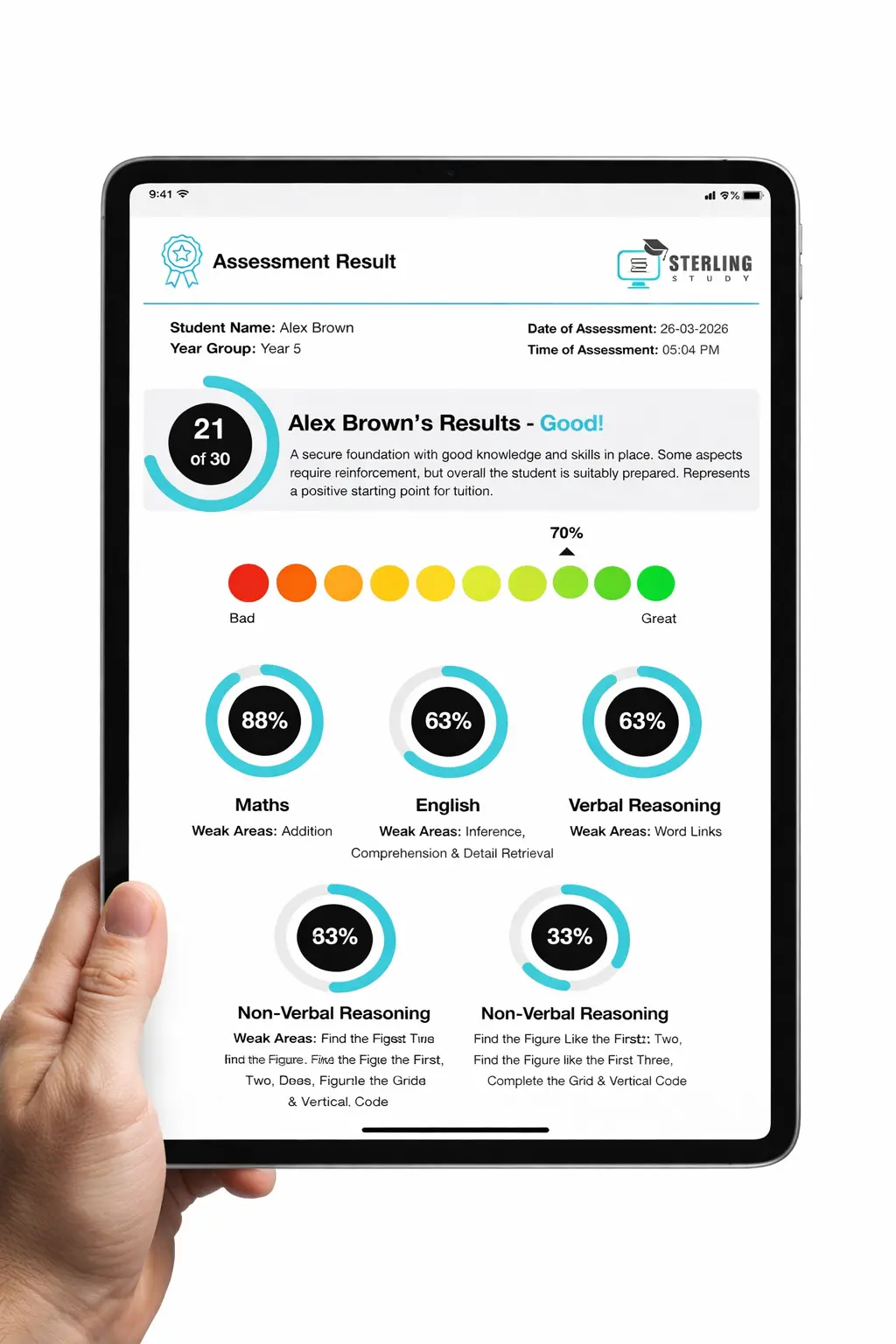
Not sure where the gaps in your knowledge are? Our PhD-led team uses a diagnostic assessment to find exactly what is holding you back before you even start.
- ✓ Subject-by-subject breakdown across all Science topics
- ✓ Time-per-question analysis
- ✓ Where you stand vs grade boundaries
- ✓ Detailed PDF results sent immediately
- ✓ No strings attached
Find My Gaps - Book Free Assessment → 1. Language vs Literature: The Complete Side-by-Side
This table is worth printing out and putting on your child's revision wall. These two qualifications are not different difficulty bands of the same subject - they are genuinely different disciplines.
| Feature | English Language | English Literature |
|---|
| Content to memorise? | No. Entirely skill-based. | Yes. Texts, quotes, context, themes. |
| Set texts? | No set texts at all. | Shakespeare, 19th-century novel, poetry, modern text. |
| Closed-book exam? | No. Extracts provided in the paper. | Yes. All quotes recalled from memory. |
| Primary test | Reading comprehension and crafted writing | Analytical essays on pre-studied texts |
| How to revise it | Timed practice, technique spotting, analytical writing | Quotation memorisation, essay planning, context |
| University requirement? | More universally required at Grade 4+ | Valued for Humanities routes |
| Writing involved? | 50% of marks are for your own writing tasks | No original writing. Analysis only. |
2. What Is GCSE English Language?
GCSE English Language is fundamentally an examination of skills, not knowledge. Your child walks into this exam with no pre-learned texts - only practised abilities: reading carefully, analysing language and structure, comparing perspectives, and writing effectively for different purposes.
The most common misconception
Many students believe English Language cannot be revised because there are no texts to memorise. This is wrong. What cannot be revised is specific content. What can and must be revised is technique - and that requires repeated timed practice with analytical feedback.
What Language Actually Tests
🔍Reading Comprehension
Extract information, identify implicit meanings, and demonstrate understanding at both surface and deeper levels from unseen texts.
✏️Language & Structure Analysis
Identify specific language choices and explain their effect on the reader. Spot how texts are constructed and organised over time.
📄Crafted Writing (50% of marks)
Paper 1 asks for narrative or descriptive writing. Paper 2 asks for viewpoint or persuasive writing for a specific audience.
Paper 2 Question 4 is consistently the most underperforming question across the country. It is the 16-mark comparison question, requiring simultaneous analysis of two writers' perspectives with embedded quotations from both sources. Most students write about each source separately and call it a comparison - earning only lower-band marks. The fix is explicit teaching of the comparison technique followed by regular timed practice.
3. What Is GCSE English Literature?
GCSE English Literature is, in almost every way, the opposite of Language in its preparation demands. Content knowledge is everything. Students study specific texts in depth and must know them thoroughly: plot and structure, characters and motivations, themes and the writer's methods, and the historical and social context in which each text was produced.
01
Shakespeare
Most commonly Macbeth. Students must know the whole play and key themes in depth.
02
19th-Century Novel
A Christmas Carol and Jekyll & Hyde are most common. Closed-book: all quotes from memory.
03
Modern Text
An Inspector Calls, Lord of the Flies, Animal Farm. One extended essay in the exam.
04
Poetry Anthology
AQA: Power & Conflict or Love & Relationships. Plus one unseen poem to analyse cold.
The closed-book challenge
The vast majority of GCSE English Literature is closed-book. Students must recall quotations, plot details, character development, and thematic arguments entirely from memory across four different texts. Effective quotation memorisation is one of the most underestimated aspects of Literature preparation.
4. How to Revise for Each Subject
Revising English Language (When It Feels Impossible)
The perception that Language cannot be revised is one of the most damaging myths in GCSE preparation. Here is a structured approach that works:
🕐One Question Per Week
Complete one reading question under timed conditions. Mark it against the mark scheme. Rewrite it. The rewriting step is almost always skipped - and it is the most important.
📋Practise Q4 Specifically
Take two newspaper articles on the same topic. Write a timed comparison of perspectives. Read model high-band answers to understand what genuine comparison looks like.
📝Write Creatively Weekly
One 45-minute timed creative writing task per week in the three months before exams. Ask: would a reader be engaged by this opening? If no, rewrite it.
Revising English Literature Effectively
Literature revision is more structured because the content is defined. For each text, build a revision document covering: plot and structure, key characters with 5-8 quotations each, major themes with textual evidence, historical context linked directly to specific moments, and a focused quotation bank of 20-30 key quotes organised by theme.
The quotation memorisation method that actually works
Read the quotation. Cover it. Write it from memory. After 24 hours, attempt it again without looking. After one week, attempt it again. This spaced retrieval practice produces significantly stronger retention than reading and re-reading. Flashcard apps like Anki automate this process well.
The step students always skip: timed essay practice. Knowing fifty quotations from Macbeth but never having written a full essay under timed conditions will guarantee underperformance. Essays must be completed and reviewed - for argument clarity, embedded evidence, quality of language analysis, and contextual integration.
5. Grade Boundaries and What They Mean
Grade boundaries are set after each exam series based on national cohort performance - they are not fixed in advance. The figures below are approximate historical ranges for reference only.
Why both English GCSEs matter — they appear on every UCAS application and every job application your child will ever submit
Gd 4
Standard Pass
Minimum for most post-16 courses. Required for all Level 3 apprenticeships.
Gd 5
Strong Pass
Required by most oversubscribed sixth forms for any A-Level course.
60%
Grade 4+
Approx. % of students nationally achieving Grade 4 or above in English Language.
Gd 5+
For A-Level Eng.
Minimum required by most schools for A-Level English Language or Literature entry.
For students aiming at top-performing sixth forms or grammar schools, a Grade 6 or above in both English GCSEs significantly strengthens the application. Russell Group universities have increasingly emphasised GCSE performance as part of contextual admissions, meaning these grades can influence university offers at 18 - even with strong A-Level results.
Frequently Asked Questions
Does my child have to sit both GCSE English Language and Literature?+
In almost all maintained secondary schools in England, yes. Both qualifications are compulsory under the national curriculum requirements for Key Stage 4. The vast majority of state schools enter every pupil for both examinations. If you are uncertain, this is worth confirming directly with the head of English at your child's school.
Which English GCSE is more important for university applications?+
GCSE English Language carries greater universal weight across all courses and subjects, as most universities specify it as part of their minimum GCSE requirements. English Literature carries particular weight for students applying to humanities and social sciences - English, History, Law, Politics, and Philosophy. For STEM applicants, Language is the relevant qualification and Literature, while it does not harm, is rarely weighted heavily.
Can a student be strong in Language but weak in Literature, or vice versa?+
This is very common and should not cause alarm. The qualifications test genuinely different cognitive strengths. A creative, spontaneous thinker may excel at Language and struggle with the closed-book memorisation demands of Literature. A disciplined, analytical thinker may prefer the defined content of Literature but find the open-ended creative writing of Language more challenging. The appropriate response is to identify which skill areas within the weaker subject are most improvable, and invest revision time accordingly.
My child is sitting Edexcel, not AQA. Is the preparation different?+
The underlying skills are broadly the same across AQA, Edexcel, and OCR - all test reading comprehension, language analysis, writing, and literary analysis. However, paper formats, question structures, mark allocations, and text selections differ significantly between boards. The most important rule: always confirm your child's board and specification code with the school, and use only that board's practice materials and mark schemes. Using AQA resources to prepare for Edexcel is one of the most common and most avoidable preparation errors.
How many quotes does my child need to memorise for Literature?+
For the Shakespeare play: 25-35 quotations across key themes, characters, and structurally significant moments. For the 19th-century novel: 20-30 quotations. For the modern prose or drama text: 20-30 quotations. For the poetry anthology: 2-3 usable quotations for each poem in the cluster (15 poems for AQA Power and Conflict). Quality matters more than quantity - a short, precise, analytically rich quotation is worth more than a long, vague one.
What is the best way for parents to support English GCSE preparation at home?+
You do not need to be an English specialist. Read with them - even 15 minutes of independent reading per day throughout Year 10 and 11 builds vocabulary and comprehension that exams reward. Talk about texts: watch a film and ask what the director was trying to show. Create the conditions for timed practice - set a timer, give them space to write, then ask simply whether the argument is easy to follow. And if your child is below their target grade by the spring term of Year 11, ask the English teacher specifically which questions on which papers they are underperforming on.
★★★★★
“I moved to the UK and was really struggling to keep up in science. My working grade was a 4 in Year 9. By the end of Year 10, I had an 8. The monthly tests kept me on track and the tutors actually noticed when I was falling behind.”
★★★★★
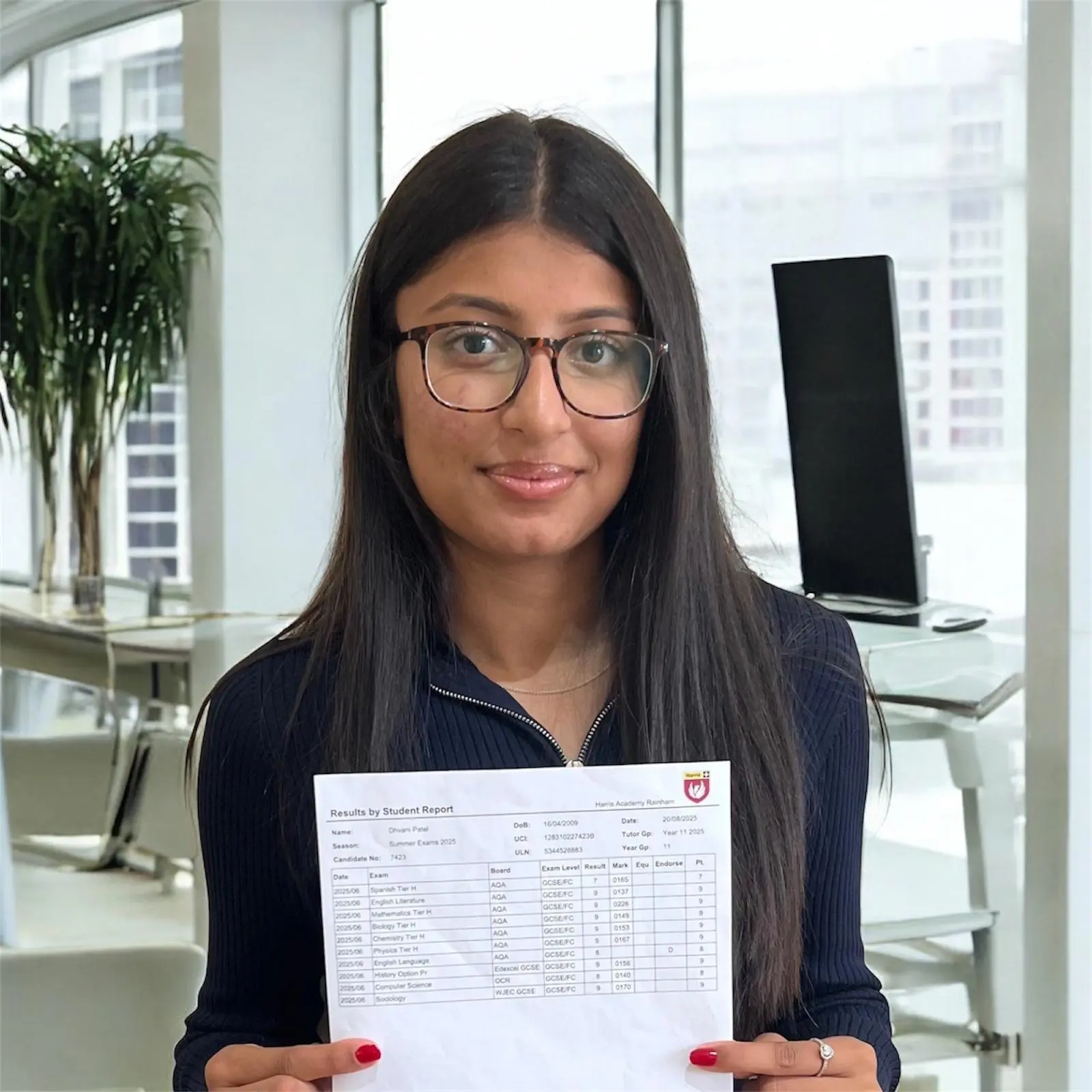
“I was aiming for 7s but ended up with grade 9s across all my GCSEs including Maths, English and all three Sciences. What made the difference was how structured the sessions were. Every class felt purposeful, not just going through the motions.”
★★★★★
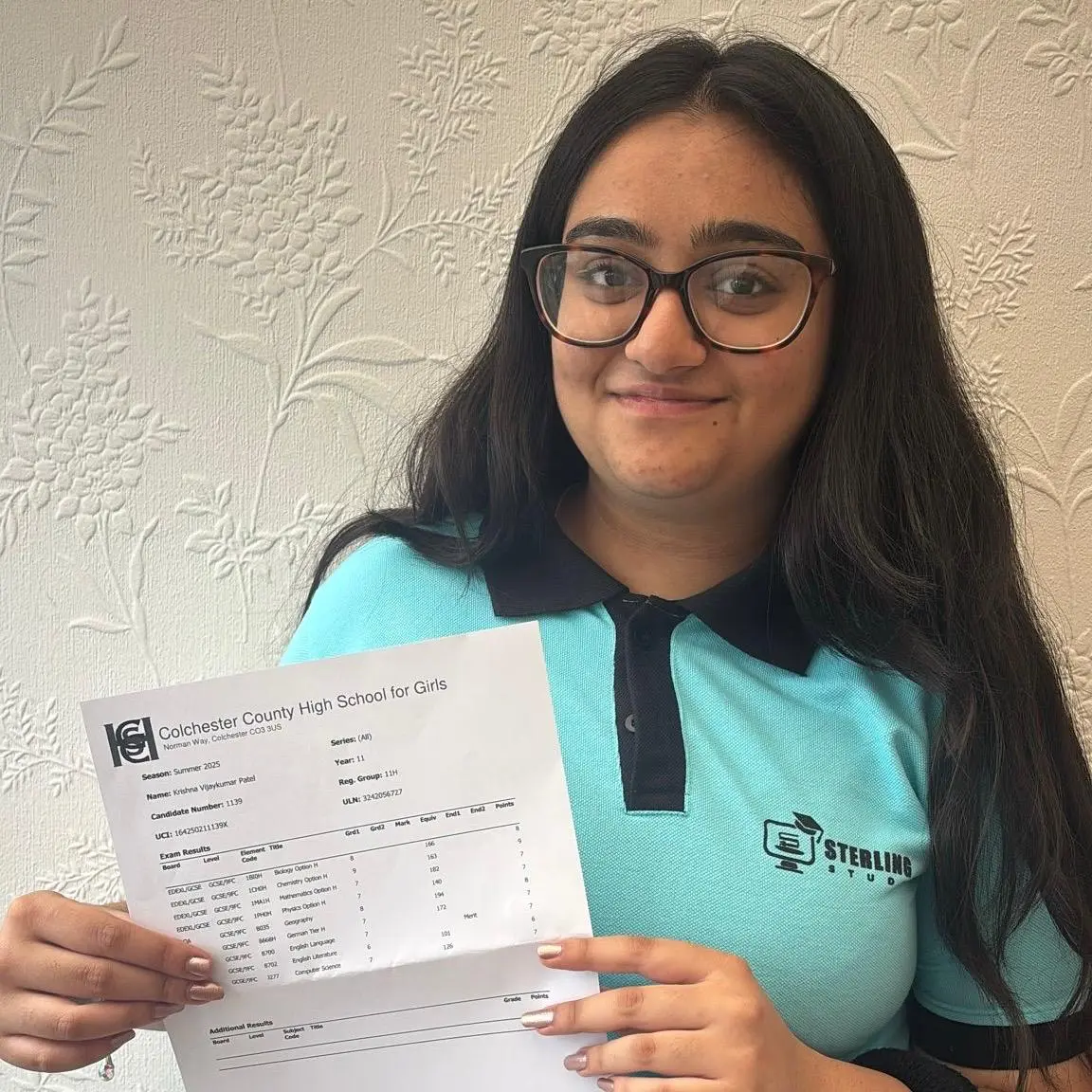
“Chemistry was the subject I dreaded most going into Year 11. Sterling broke it down in a way school never quite managed. I walked out of my chemistry exam feeling confident for the first time and got a 8 in the end.”
★★★★★
“I moved to the UK and was really struggling to keep up in science. My working grade was a 4 in Year 9. By the end of Year 10, I had an 8. The monthly tests kept me on track and the tutors actually noticed when I was falling behind.”
★★★★★
“I was aiming for 7s but ended up with grade 9s across all my GCSEs including Maths, English and all three Sciences. What made the difference was how structured the sessions were. Every class felt purposeful, not just going through the motions.”
★★★★★
“Chemistry was the subject I dreaded most going into Year 11. Sterling broke it down in a way school never quite managed. I walked out of my chemistry exam feeling confident for the first time and got a 8 in the end.”
Our Course
GCSE English Programme — Language & Literature
Expert-led system · Online · No contract