Search "how to get a Grade 9 in GCSE English" and within thirty seconds you will find hundreds of articles, videos, and revision guides telling students the same three things: use PEEL paragraphs, identify language techniques, and include some historical context. That advice will get a student to Grade 5. It will not get them to Grade 8 or Grade 9 — no matter how consistently it is applied — because Grade 8 and Grade 9 writing requires a fundamentally different kind of thinking.
✓ FREE · 30 mins · No ObligationFind your gaps.
Fix them.
For free.
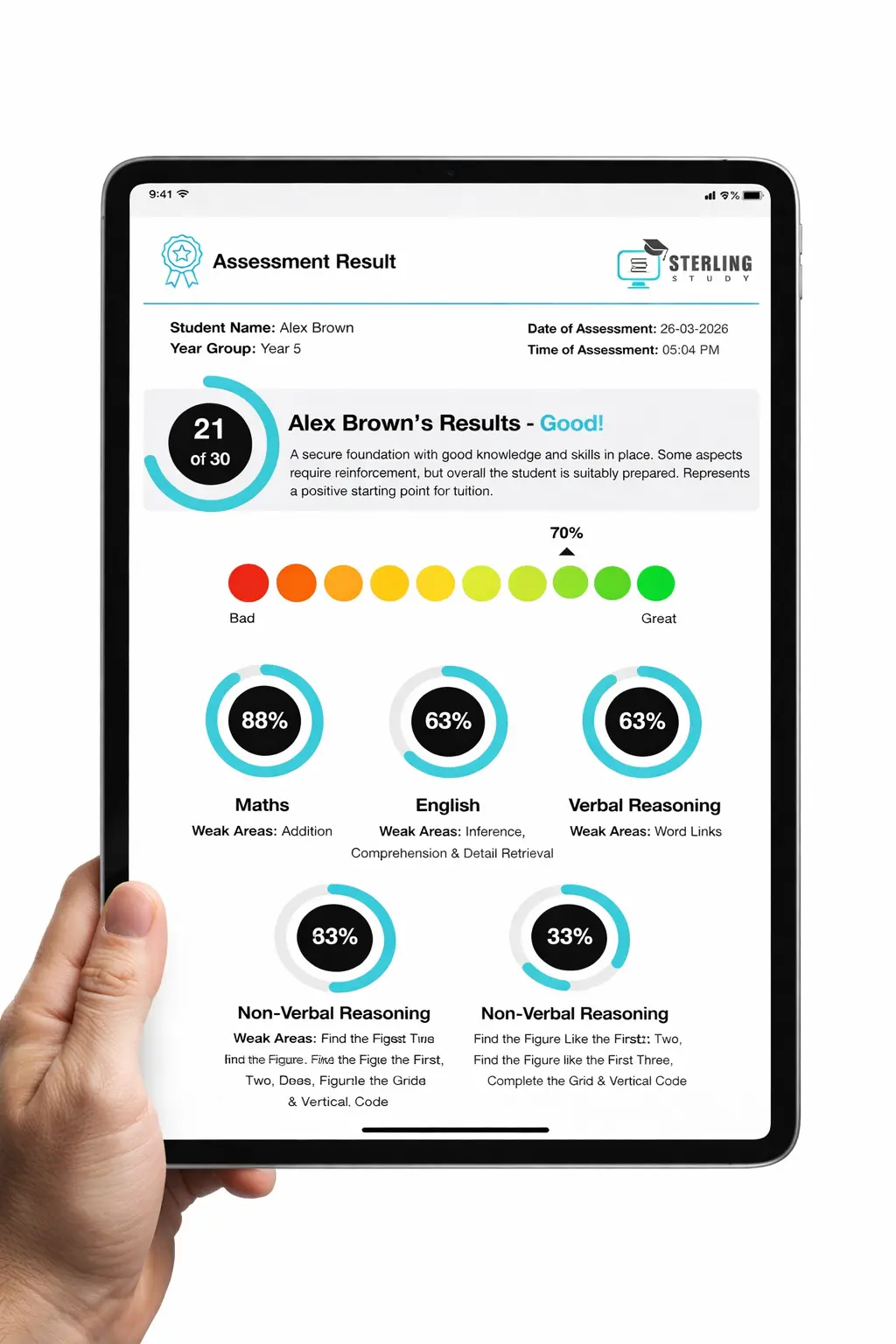
Not sure where the gaps in your knowledge are? Our PhD-led team uses a diagnostic assessment to find exactly what is holding you back before you even start.
- ✓ Subject-by-subject breakdown across all Science topics
- ✓ Time-per-question analysis
- ✓ Where you stand vs grade boundaries
- ✓ Detailed PDF results sent immediately
- ✓ No strings attached
Find My Gaps - Book Free Assessment → 1. Why Standard Advice Gets You to Grade 5, Not Grade 9
The problem is not that PEEL is wrong. It will produce competent, functional analysis that demonstrates basic understanding. It does not generate perceptive analysis because it does not ask perceptive questions. What most revision resources fail to do is show students what better analysis actually looks like at the word level — what examiners mean when they write "perceptive" on a mark scheme, and what separates a paragraph that earns four marks from one that earns seven.
The core insight
Grade 8 and Grade 9 writing requires a different kind of thinking, not just more thinking of the same kind. This guide addresses that gap directly — with real before-and-after examples, specific mark scheme analysis, and a framework for practising the right skills.
2. What Examiners Are Actually Rewarding
Before any technique discussion, it is worth understanding exactly what the AQA mark scheme descriptors at each grade boundary actually require. These are public documents. Reading them carefully is itself one of the most useful revision activities a student can do.
| Grade | AQA Descriptor | What It Means in Practice |
|---|
| Grade 9 | Perceptive, detailed, convincing | A coherent argument with depth of analysis and a reading that goes beyond what is immediately obvious |
| Grade 8 | Perceptive, detailed | Depth of analysis throughout; a clear argument sustained from introduction to conclusion |
| Grade 7 | Thoughtful, developed | Goes beyond the obvious; develops ideas rather than just stating them |
| Grade 6 | Explained, structured | Clear explanation with some development; some connection between points |
| Grade 5 | Some clear points | Points are made but not deeply explored; limited connection between ideas |
| Grade 4 | Simple, aware | Basic understanding of the text; limited analytical engagement |
Perceptive means the student identifies something genuinely unexpected in the text: an ambiguity, a tension, a contradiction, a detail that illuminates the whole. It is not achieved by using sophisticated vocabulary. It is achieved by genuinely noticing something worth noticing. Many students trying to move from Grade 6 to Grade 8 focus on making their writing sound more sophisticated rather than making their thinking more perceptive — and that never moves the grade.
3. The Zoom Technique: The Most Effective Analytical Method for GCSE English
The Zoom technique is the most consistently effective single method for producing Grade 8 analysis we have encountered across years of teaching GCSE English. It works because it structures the exact movements of thinking that examiners reward at the top grade boundaries. It operates through five levels, applied within a single analytical paragraph.
01
The Word
Begin at the level of a specific word or very short phrase. Ask: why this word, not a near-synonym? Do not begin with the technique category.
02
The Character or Speaker
Zoom out to what this word choice tells us about the character's psychology, their situation, or their relationship to other characters.
03
The Theme
Zoom out further to the thematic level. How does this word connect to, develop, or complicate a theme that runs through the whole work?
04
The Context
Zoom out to the contextual level. What would the original audience have understood that adds meaning to this specific word choice?
05
Return to the Question
Return directly to the question with a deepened answer. The paragraph's conclusion should say something more interesting than its opening claim.
One paragraph. Five levels. This is what "perceptive, detailed" looks like when it is fully executed.
4. The Zoom Technique in Practice: Before and After
The following examples use the same evidence from Great Expectations by Charles Dickens. The quotation is the same. The evidence is the same. The difference is entirely in what the student does with that evidence.
Example 1: "crouching" — Great Expectations
✗ Grade 5 Version
~9/20
"Dickens uses the word 'crouching' to show that Pip is scared. This creates a tense atmosphere and makes the reader feel sorry for Pip."
Identifies a basic effect — no engagement with why this specific word; could apply to any verb in any scene.
✓ Grade 8 Zoom Version
~15/20
"The verb 'crouching' positions Pip physically and psychologically beneath Magwitch before a word has been exchanged between them. Dickens' selection of this verb over 'cowering' or 'hiding' is deliberate and precise: crouching encodes both prey and potential predator simultaneously, an ambiguity that anticipates the novel's persistent question of where victimhood and criminality actually diverge. A cowering figure is entirely passive; a crouching figure is also, potentially, coiled. Writing in 1861 for an audience entirely familiar with the brutality of class-inflected criminal justice, Dickens opens Great Expectations at the absolute bottom of the social hierarchy to ask who, exactly, is being hunted, and by which forces. The social structure, this opening moment suggests, is itself the predator."
Same evidence. Six additional marks. Perceptive ambiguity identified; context integral to the argument.
Example 2: "unsex me here" — Macbeth
✗ Grade 5 Version
~9/20
"Lady Macbeth says 'unsex me here' which shows she wants to become more masculine so she can commit murder. Shakespeare uses this to show that Lady Macbeth is ambitious and ruthless."
States the general sentiment; the word "unsex" could be swapped for any phrase about ambition without changing the analysis.
✓ Grade 8 Zoom Version
~15/20
"The verb 'unsex' is among the most violent acts of self-directed language in the play. Lady Macbeth does not ask to be made stronger or braver; she asks for her biological identity to be erased. For a Jacobean audience for whom femininity was defined by passivity and submission to male authority, this represents not ambition but self-annihilation. Shakespeare is not simply showing us a villain here — he is showing us a character who understands that the social structures surrounding her have made her complicit in her own incapacity, and who is willing to destroy herself to escape that complicity. The horror is not that Lady Macbeth wants power. It is that she believes the only path to it requires ceasing to exist as herself."
Interrogates the specific word; context is integral; the final sentence says something the opening sentence does not.
5. How to Build an Argument, Not Just a List of Points
One of the clearest markers separating Grade 7 from Grade 8 is essay structure at the macro level. Grade 7 essays contain well-developed individual paragraphs that do not consistently connect to each other. Grade 8 essays contain paragraphs that build a cumulative argument.
✗ Grade 5 Structure — A List
Point 1: Pip is scared.
Point 2: Miss Havisham represents the past.
Point 3: Estella is cruel.
Conclusion: Dickens uses many techniques to explore themes.
Each point is separate. The conclusion could have been written before the essay.
✓ Grade 8 Structure — An Argument
Opening claim: Dickens presents criminality not as individual moral failure but as the product of structural social violence.
P1: Established physically in Pip's crouching posture — both child and convict as prey.
P2: Deepened with Miss Havisham, whose victimhood makes her a perpetrator of the same damage.
P3: Most complex in Magwitch, whose wealth funds the gentility English society pretends is natural.
Conclusion: Great Expectations is a novel about the violence polite society performs to avoid seeing itself clearly.
The conclusion could not have been written at the start — it is earned through the analysis.
The planning test
Before writing, spend five minutes asking: what does each paragraph add to the overall claim? If the answer is "another example of the same thing," the essay is a list, not an argument. A strong essay can be summarised as "I argued X because A, B, and C — and the relationship between A, B, and C is itself significant."
6. Context: The Difference Between Integration and Dumping
Context is worth marks at GCSE English Literature. It is also one of the most consistently mishandled elements in student essays. The problem is not that students do not know their context. The problem is what they do with it.
✗ Context-Dumping
"Dickens was writing in the Victorian era, when poverty was a widespread problem in society and the Industrial Revolution had created a large gap between the rich and the poor."
This sentence could appear in any essay on any Dickens novel. It adds no analytical value. Examiners call this "bolted-on context."
✓ Integrated Context
"Writing in 1861 for an audience entirely familiar with the brutal realities of class-inflected criminal justice, Dickens' selection of 'crouching' positions the social hierarchy itself as predator. His Victorian readers would have understood, without being told, what the criminal justice system did to men like Magwitch. The word choice asks them to notice what they already know."
Remove the context from this sentence and the analysis collapses. That is the test for integration.
7. Quotation Selection: Why Less Is More
One of the most common misconceptions about high-grade essays is that they contain a large number of quotations. Examiners report the opposite pattern. Grade 8 and Grade 9 essays typically contain fewer, shorter, more precisely selected quotations — each analysed in significant depth.
🔍Five Words or Fewer
For most analytical paragraphs, one or two words is ideal. Short quotations force you to commit to a specific analytical choice and develop it fully.
📝5–8 Total Quotations
Five to eight precisely selected, deeply analysed quotations will consistently outperform fifteen long quotations with surface-level comment.
🔹Ask "Why This Word?"
The question "why did Dickens choose 'crouching' rather than 'hiding'?" generates a specific, analytical answer. Broad questions generate broad answers.
8. The Essay Structure That Works at Grade 8 and Above
| Section | Grade 8 / Grade 9 | Grade 5 / Grade 6 |
|---|
| Introduction | A nuanced, arguable claim the essay will develop and deepen | A restatement of the question as a declarative sentence |
| Opening sentence | The essay's central argument, stated precisely and interestingly | "In this essay I will discuss how the writer presents…" |
| Body paragraphs | Each adds a new layer of insight, building a cumulative argument | Each makes a separate observation unconnected to a central claim |
| Quotation | One short, precisely chosen quotation; word-level analysis | Long quotation followed by "this shows that…" |
| Context | Threaded into analysis — removing it would collapse the point | One historical background sentence attached to a paragraph |
| Transitions | Each paragraph's conclusion sets up the next development | "Another technique the writer uses is…" |
| Conclusion | Returns with a deepened insight earned through the essay | "In conclusion, I have shown that the writer uses many techniques…" |
9. How to Write a Grade 9 Introduction and Conclusion
The Introduction
The introduction should be two to four sentences and should state the essay's argument — not summarise what the essay will cover. It should be specific enough to be interesting and arguable enough to require the rest of the essay to prove it.
✗ Grade 5 Introduction
"In this essay I will discuss how Dickens presents the theme of poverty in Great Expectations. Dickens uses many language techniques to show that poverty affects the characters in different ways."
Contains no argument. Could apply to any essay on any Dickens novel.
✓ Grade 9 Introduction
"Great Expectations is structured as a novel of education, but what Pip learns is not what he or the reader expects. By the novel's end, the education Dickens values is not the acquisition of manners or money but the capacity to see clearly the violence that English social structure performs on those at both its top and its bottom. Pip's 'great expectations' are, in the novel's central irony, the greatest trap in a story full of traps."
Makes a specific, arguable claim. Another student could disagree with this reading — that is the mark of a real argument.
The Conclusion
The conclusion's purpose is not to summarise. A summary conclusion signals that the essay has been a list rather than an argument. A Grade 9 conclusion says something that could only be said after the analytical work has been completed.
✗ Grade 5 Conclusion
"In conclusion, I have shown that Dickens uses many language techniques to present the theme of ambition in Great Expectations. Great Expectations is an interesting novel because it explores many important themes."
Adds nothing. Could have been written before the essay.
✓ Grade 9 Conclusion
"What makes Great Expectations genuinely unsettling is not that Pip learns to see through his own snobbery. It is that Dickens refuses to offer him, or the reader, a world that has been corrected by that seeing. Magwitch dies. Estella is damaged. The social machine continues. Pip's moral education is real and it changes nothing structural. That is not pessimism. It is the novel's most honest and most radical insight: that individual understanding, however hard won, is not the same as structural change."
Earns its place. Says something that could only be said after the body paragraphs have been completed.
Sterling Study GCSE results — 90% of students achieve Grade 6 and above
90%
Grade 6+
Achieved in Maths, English and Science
3 in 4
2+ Grades Up
Students improve by 2+ grades within a year of joining
Senior
Examiners
Every session led by specialist English teachers and markers
NO
Contracts
Stay because of results, not paperwork
10. The Most Common Reasons Strong Students Get Stuck at Grade 6 or 7
Students achieving Grade 6 or Grade 7 are doing something right. The gap to Grade 8 is real but it is also specific. These are the five reasons we see most consistently.
1
Analysis identifies technique rather than interrogating word choice
Writing "Dickens uses a verb to convey Pip's vulnerability" names the technique category but does not explain why this verb, why now, and why this word rather than an alternative. Naming without interrogating is Grade 5 thinking in slightly more sophisticated language.
2
Each paragraph makes a new point rather than developing a central argument
The essay reads as a list of observations. Each paragraph is self-contained. Moving to Grade 8 requires reconceiving the essay as an argument, not a tour of the text's features.
3
Context is added to rather than integrated into analysis
This is the single most efficient fix available. Learning to write context into the analysis rather than alongside it typically adds a grade boundary by itself.
4
Quotations are too long
Long quotations force the student to comment on too many things at once. The analysis becomes general. Cutting quotations to five words or fewer and committing to deep analysis of the most interesting word produces immediately stronger writing.
5
The introduction and conclusion do not frame an argument
A strong essay framed by a clear opening argument and a developed concluding insight reads as Grade 8 even when the body paragraphs are working at Grade 7 level. Improving the frame has an outsized effect on how an examiner reads the whole.
11. How to Practise Effectively Before the Exam
Effective GCSE English preparation in the final four to eight weeks is not about reading more revision notes. It is about practising writing under exam conditions and receiving specific feedback against actual mark scheme criteria.
⏱One Timed Essay Per Week
Written under real exam conditions and marked against actual AQA mark scheme descriptors by a qualified teacher or specialist tutor. This is the highest-impact single activity in the final preparation period.
🔧Paragraph-Level Drills
For students working on a specific weakness, write one paragraph applying the Zoom technique to a single quotation. Evaluate it. Rewrite it. Focused repetition ingrains the technique faster than full essays.
📖Active Re-Reading
Re-read with a pen and mark moments of interesting word choice — words where asking "why this word?" produces an interesting answer. Build a bank of 5–8 key moments per text analysed at word level.
Why timed practice beats revision notes
A student who writes an essay and receives "Grade 6 — work on context integration" has actionable information. A student who reads revision notes about context integration has theoretical knowledge that may or may not translate into exam performance. Exam performance in English is a skill, and skills improve through deliberate practice with specific feedback.
12. Frequently Asked Questions
What is the difference between a Grade 8 and a Grade 9 in GCSE English?+
At AQA, Grade 9 essays are described as "perceptive, detailed, and convincing." The distinction in practice is the presence of genuine critical originality: an unexpected reading, a noticed ambiguity, or an analytical insight that goes beyond what the majority of well-prepared students will produce. A Grade 8 essay consistently applies perceptive analysis throughout. A Grade 9 essay does that and additionally offers at least one moment of genuine surprise — a reading that makes the examiner pause and recognise that this student has noticed something interesting. Grade 9 is the top approximately four percent of all entries nationally.
Should my child stop using PEEL paragraphs for Grade 8?+
PEEL is a useful scaffold for building the habit of pairing evidence with comment, which is essential at Grade 4 and Grade 5. At Grade 7 and above, PEEL becomes limiting because it produces a predictable, mechanical structure that does not generate the kind of developed, cumulative analysis the mark scheme rewards at the top grades. Students aiming for Grade 8 should move toward argument-led paragraphs applying the Zoom technique. This does not mean abandoning the habit of evidencing claims — it means replacing the mechanical structure with a more analytically driven approach.
How many quotations should a GCSE Literature essay include?+
For a full Literature essay in an exam context, five to eight precisely selected short quotations analysed at word level will consistently outperform essays with fifteen or more long quotations commented on superficially. The mark scheme rewards depth of analysis, not quantity of evidence. A student who selects one word from a quotation and analyses it across five analytical layers will earn more marks than a student who identifies the techniques in a four-line passage and notes their general effect.
What does "perceptive analysis" actually mean?+
Perceptive analysis means noticing something in the text that is not immediately obvious. It involves identifying ambiguity, tension, or contradiction; making a connection between a specific word choice and a wider thematic concern; or offering an interpretation that is surprising but supportable. It is not achieved by using sophisticated vocabulary or complex sentence structures. It is achieved by genuinely looking at a word and asking "why this word, not another?" until the answer produces something worth saying. Examiners describe perceptive responses as those that make them think "I hadn't noticed that, but they are right."
My child understands the texts but performs poorly in exams. What is going wrong?+
This is one of the most common patterns in GCSE English preparation. A student who can discuss texts fluently in class but produces significantly weaker work under timed exam conditions is experiencing performance anxiety, insufficient practice under exam conditions, or both. The solution is regular timed writing practice, not more discussion of the texts. The gap between understanding a text and performing under time pressure is closed by practice, not by further study of the material. Introduce timed paragraph practice first, then timed half-essays, then full timed essays.
How important is spelling and grammar for GCSE English grades?+
Spelling, punctuation, and grammar (SPaG) are explicitly assessed in AQA GCSE English. In English Language, writing tasks are assessed partly on technical accuracy. In English Literature, SPaG is assessed but weighted less heavily than analytical quality. A student who writes with consistent technical accuracy has removed a potential barrier to marks, but improving SPaG alone will not move a student from Grade 5 to Grade 8. The analytical quality of the work is the primary driver of the grade.
What is the best way to revise set texts for GCSE English Literature?+
Active re-reading is significantly more effective than passive re-reading or making revision notes. Re-read with a pen and mark moments of interesting, specific word choice — particularly moments where asking "why this word?" produces an interesting answer. Build a short but analytical bank of five to eight key moments per text that repay deep analysis. Do not try to memorise extensive quotation lists. Instead, understand three to five key moments in each text well enough to analyse them at word level from memory. Re-reading without writing practice does not improve exam performance efficiently.
What is the highest-impact activity to do in the four weeks before GCSE English exams?+
One timed, full essay per week, written under real exam conditions and marked in detail against the actual AQA mark scheme descriptors by a qualified teacher or specialist tutor. The feedback should identify specifically which mark scheme boundary the essay sits at and give no more than two specific, actionable things to change. This is more effective than re-reading texts, watching revision videos, completing past paper comprehension questions, or making revision notes.
13. The Grade 9 Checklist
Use this checklist to evaluate any GCSE English essay before submission or after a timed practice session.
Analysis
✓Does each paragraph interrogate a specific word, not just a technique category?
✓Does the analysis ask "why this word rather than an alternative?"
✓Does the analysis move through at least three levels: word, character, theme?
Argument
✓Does the introduction make an arguable claim about the text?
✓Does each paragraph add a new layer to the argument, not just a new piece of evidence?
✓Does the conclusion say something that could not have been written at the start?
Context & Quotation
✓Is contextual information integrated into analytical points rather than attached to them?
✓Would the analytical point collapse if the context were removed?
✓Are most quotations five words or fewer?
✓Is there deep word-level analysis of a specific word in each quotation?
Structure
✓Does the essay read as a developing argument from introduction to conclusion?
✓Does each paragraph's conclusion set up the next paragraph's opening?
Our Course
GCSE English Programme — Language
Senior examiner-led · Essay marking against real AQA criteria · No contract